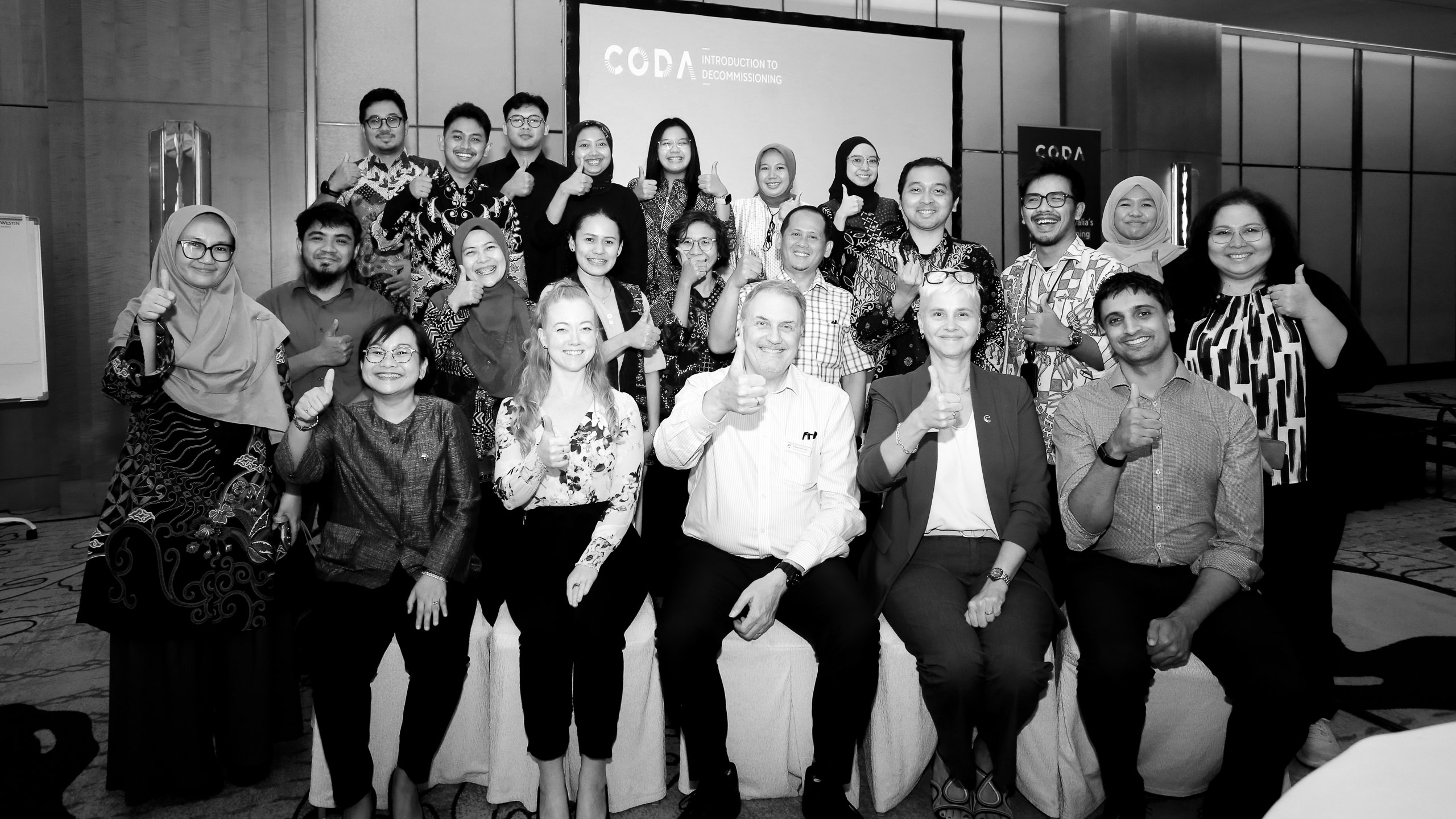
CODA, in collaboration with the Department of Industry, Science and Resources (DISR) and the National Offshore Petroleum Safety and Environmental Management Authority (NOPSEMA), recently delivered a two-day offshore oil and gas decommissioning workshop in Jakarta for Indonesian government officials and operators.
Held on 14–15 July 2026, the workshop brought together 40 participants to support knowledge exchange between Australian and Indonesian stakeholders and build capability in managing the challenges associated with offshore oil and gas decommissioning.
Australia and Indonesia share a common interest in effective offshore decommissioning outcomes, with both countries preparing for significant decommissioning activity in the coming decades. Building understanding between regulators and government officials provides an opportunity to share experiences, compare approaches and strengthen collaboration across the region.
The workshop was developed to provide participants with practical insights across the offshore decommissioning lifecycle, from regulatory frameworks and planning through to execution, environmental management and sustainability considerations.
Sessions covered a range of topics including international and Australian regulatory frameworks, Indonesia’s regulatory approach, well decommissioning, facility and subsea decommissioning, late-life asset management, platform reutilisation, cost estimation, hazardous materials management and environmental assessment.
The program also included contributions from Australian and Indonesian government representatives, including NOPSEMA, DISR’s Northern Endeavour branch, and Indonesia’s Ministry of Energy and Mineral Resources (ESDM), providing participants with perspectives from both jurisdictions.
Reflecting on the importance of collaboration in supporting future decommissioning outcomes, CODA CEO Dr Francis Norman said:
“Time and time again, we hear at industry conferences and forums that collaboration will be critical to addressing the challenges of offshore decommissioning. This workshop was a great example of that in practice, bringing together Australian and Indonesian stakeholders to share experiences, discuss different approaches and build a stronger understanding of the opportunities and challenges ahead.
“As countries across the region prepare for increasing decommissioning activity, continued knowledge exchange and cooperation will be an important part of supporting safe, sustainable and effective outcomes.”
As part of the broader capability-building initiative, CODA also developed a version of its recently released online well plug and abandonment training module, adding Bahasa Indonesia subtitles. The module provides an additional resource for Indonesian officials to continue building their understanding of key decommissioning concepts beyond the workshop.
Feedback from participants highlighted the value of sharing practical experiences and learning about different approaches to offshore decommissioning.
“This workshop provided an Australian decommissioning practice perspective in quite some detail, starting from legal and regulation, planning, cost estimation and execution. Thank you for the opportunity and new knowledge being shared.”
The workshop represents an important step in ongoing Australia–Indonesia collaboration on offshore decommissioning, supporting greater understanding of the technical, regulatory and operational considerations involved in managing offshore assets through their end-of-life phase.
CODA extends a huge thankyou to DISR, NOPSEMA, ESDM, and all participants involved in delivering this valuable knowledge exchange opportunity.