
CODA Partners Receive Discount on ICCPM Complexity Qualification

As part of CODA’s strategic partnership with the International Centre for Complex Project Management (ICCPM), CODA Partners can access a $300 discount on ICCPM’s nationally accredited Certificate IV in Navigating Project Complexity (11420NAT).
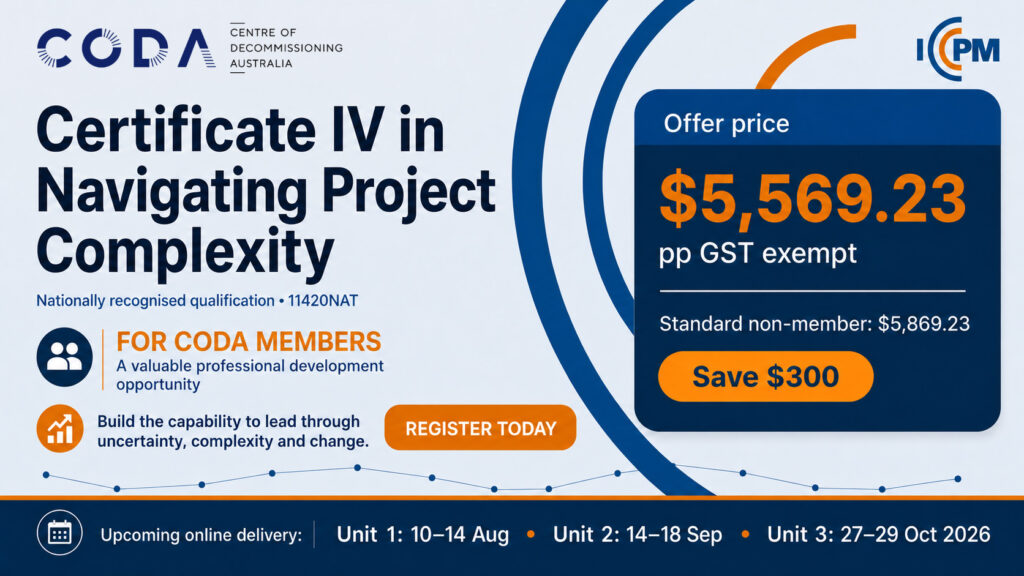
The opportunity aims to support professionals facing increasingly complex operating environments, where uncertainty, interconnected risks, stakeholder challenges and rapid change are becoming defining features of project delivery.

While decommissioning projects present their own unique challenges, many of the factors involved, including uncertainty, stakeholder interdependencies, evolving risks and changing requirements, are common across major project environments.

The Certificate IV in Navigating Project Complexity is designed to support professionals working within complex project environments by providing practical frameworks, systems thinking capabilities and leadership skills that can be applied across a range of sectors and project contexts.

ICCPM notes that organisations are increasingly seeking leaders and practitioners who can successfully navigate complexity and improve organisational outcomes in dynamic environments.

Watch ICCPM’s overview video to learn more about the Certificate IV in Navigating Project Complexity.

ICCPM Chief Executive Officer Collin Smith said organisations are increasingly recognising that traditional project management approaches alone are often insufficient when operating within highly interconnected systems.

“The ability to understand and navigate complexity is rapidly becoming an essential capability for project professionals and organisational leaders alike. This qualification provides practical skills that help participants better manage uncertainty, interdependencies and stakeholder complexity while improving project outcomes.”

The next online intake will be delivered across three stages:

  • Unit 1: 14-18 September
  • Unit 2: 19-23 October
  • Unit 3: 10-12 November

CODA Partners interested in learning more about the Certificate IV in Navigating Project Complexity can visit ICCPM’s course page or contact ICCPM directly for further information, including pricing, payment options and enrolment details.

View Course Page

CODA Parter Discount

CODA Partners interested in accessing the $300 discount can obtain the unique enrolment code by contacting the CODA team via contact@decommissioning.org.au

Terms and Conditions

Offer applies to CODA Partners only. A unique enrolment code must be quoted at the time of registration to access the discount. The offer cannot be transferred, exchanged or combined with any other promotion.

Enrolment is confirmed upon completion of registration and payment. ICCPM reserves the right to withdraw the offer after 7 August 2026.

Aquaterra Energy & James Fisher Launch Integrated Global Decommissioning Partnership

Aquaterra Energy, a leading provider of intelligently-engineered products and services for well access and offshore developments and James Fisher and Sons plc (James Fisher), a global provider of specialist marine and energy solutions driving offshore energy forward, have formed a strategic global partnership to streamline offshore decommissioning delivery. The collaboration provides operators with a single, integrated route to plan and execute well abandonment and infrastructure removal programmes more efficiently, with fewer interfaces and greater execution certainty.

Under the partnership model, Aquaterra Energy is leading front-end engineering and well access solutions, while James Fisher through its energy division is delivering subsea operations and offshore execution expertise. Together, they offer a more coordinated alternative to traditional decommissioning models, connecting early planning, engineering, well access and offshore execution under a clearer delivery framework. This gives operators fewer handovers, stronger accountability and greater certainty from initial scope development through to execution, while retaining the flexibility to adapt as project requirements evolve.

The collaboration will operate globally, with initial focus on the North Sea, APAC and the Middle East – regions where significant number of offshore wells and infrastructure are approaching permanent abandonment. In the UK Continental Shelf alone, the North Sea Transition Authority reports 153 wells past decommissioning consent deadlines, with £44 billion still to be spent on decommissioning. In Australia, government modelling estimates offshore decommissioning liabilities could reach approximately £48 billion over the next 30-50 years and globally, more than 2,500 offshore structures are expected to require decommissioning by 2040. This growing workload is driving demand for more efficient delivery models.

Matt Marcantonio, Head of Engineering at Aquaterra Energy, said:

“Decommissioning programmes are increasingly moving away from simple, isolated scopes. The next generation of projects will require tight engineering control, early integration and the ability to adapt quickly as conditions change. By aligning our expertise with James Fisher from the outset, we can shape more efficient scopes, prevent downstream redesign and ultimately reduce offshore duration. We see this as a way to give operators the confidence to take on decommissioning programmes that are becoming more technically demanding and commercially pressured, while keeping the agility needed to respond as projects evolve.”

Mark Stephen, Product Line Director – Decommissioning & CFE at James Fisher Energy, commented:

“What operators are looking for now is delivery confidence, predictable execution, fewer interfaces and teams who already understand how to work together. By combining our subsea operations capability with Aquaterra Energy’s early engineering and well access expertise, we can remove many of the common friction points that slow projects down offshore. This model gives operators a scalable, field-proven approach that directly supports safer, more efficient execution as global decommissioning activity accelerates.”

The partnership will operate on a project-by-project basis, with team composition determined by scope, including the use of cross-trained crews to reduce the number of people offshore (POB) and lower overall exposure to risk.

Each company remains independent, working within an agreed framework to ensure early collaboration and aligned delivery. The partners are already engaging with operators on upcoming decommissioning opportunities across multiple regions.